
Signs of Anxiety in Children
Excessive anxiety is the most common mental health issue for children. The most common anxiety disorders are discussed below.
5/8/20246 min read

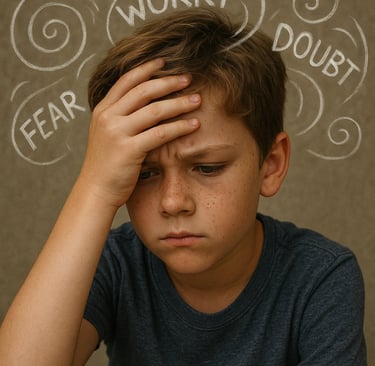
If the symptoms result in significant disruption to everyday life, seem excessively persistent, are too intense for the situation, or simply appear odd, you should contemplate the possibility that your child might have an anxiety disorder. Without proper understanding and the right approach, anxiety disorders can likely continue into adulthood.
Recognizing the specific type of anxiety can enhance the understanding of symptoms. Knowing the most prevalent types of anxiety and their related symptoms can help demystify the issue. Below is a list of some of the most common anxiety challenges.
Most Common Types of Childhood Anxiety
Emetophobia – Emetophobia is the fear of vomiting, others vomiting, or the effects of vomiting. It is from the greek word “emesis” meaning vomit and “phobos” meaning fear. Virtually everyone has heard of phobias in children like fear of needles or snakes. However, people are often surprised this is a phobia. When something triggers a fear response, one thing the body does is shift its resources to parts of the body needed for defense. The digestive system is not needed for defense so that shift can result in stomach discomfort. So unlike many phobias, a child’s body becomes a trigger for the fear. The fear and attempted solution results in actions or symptoms such as these:
Avoiding contact with anything associated with vomit or things that could lead to vomiting
Avoiding words, images or sounds associated with vomiting
Asking over and over for reassurance of not being sick
Restricting kind or amount of food to prevent throwing up
Monitoring feelings in throat, esophagus and stomach for signs of nausea
Avoiding activities that could lead to dizziness or overheating
Increasing anxiety at any sign of stomach distress
It can be hard to diagnose in children because even though you can tell your child is anxious, when you ask your child about it, he or she may not disclose key details. This is because they don’t want to talk and/or don’t want you to talk about it for fear that will lead to being nauseated.Like any anxiety problem it can range from a mild problem to major impairment.
Separation Anxiety Disorder - It is common for children to experience a period where it is challenging to be apart from their parents—whether it be during school, childcare, or at church. This constitutes a typical stage of development. However, for some children, this anxiety can become significantly more pronounced. Central to separation anxiety is a child’s fear that something dreadful will occur—either to themselves or to a parent or caregiver—leading to a lasting separation. For instance, a child might worry about being abducted or fear that a parent could be involved in a serious accident. Issues often intensify when a child declines to attend school or goes but is continually experiencing distress. Other children might cope with school but resist sleepovers, demand to sleep next to a parent, or frequently interrupt their parents’ room at night. Depending on the age of the child and the family circumstances, separation anxiety can be highly disruptive. It may hinder a parent's ability to work. Schools might not be accommodating when absences increase, based on local guidelines. The child’s social interactions are frequently impacted as well, as they may steer clear of scenarios where friendships typically develop. Consequently, both parents and children may resort to making excuses to maintain these relationships.
Phobia – Phobias are the most common type of anxiety disorder. They are generally grouped into five categories: animal, environmental, medical, situational, and other. Within each category, there are many different types of phobias. Often, the things people fear are understandable. For example, most people are startled by a sudden clap of thunder. What makes a fear a phobia is the intensity of the anxiety. The fear is extreme, can feel overwhelming, and may even lead to panic. One of the most common phobias that requires treatment is emetophobia, or the fear of vomiting. Many children also fear medical situations, such as going to the dentist or getting a shot. Situational fears may involve bridges, elevators, or small enclosed spaces. Animals and insects—especially flying bugs—can also cause significant anxiety for some children. Finally, there are fears that do not fit neatly into other categories, such as fear of clowns or people in costumes. The ones that require treatment are ones that interfere with life either frequently or dramatically.
Obsessive Compulsive Disorder (OCD) - OCD comprises two main components: 1) persistent alarming thoughts that do not dissipate (obsessions) and 2) an intense urge to perform actions to prevent or mitigate these thoughts (compulsions). There are numerous variations of OCD, which can make it challenging to identify. Obsessions are distressing thoughts about potential catastrophic events, often intrusive and difficult to dismiss. These thoughts can feel like they pose a significant threat to something of great importance in your life, contributing to fearfulness. The intensity of these obsessions can fluctuate, but they consistently lead to anxiety or distress. Such thoughts are unwelcome and resist any effort to eliminate them. Compulsions refer to the behaviors aimed at addressing the obsessions. Common compulsive actions include cleaning, washing, checking, repeating, and organizing items. Sometimes, the compulsions manifest in more psychological ways, such as confessing, suppressing thoughts, redoing thoughts, evading certain thoughts, and counting, among others. There exists a strong drive or impulse to engage in these behaviors. These compulsions are efforts to alleviate the distressing feelings. It is evident that a behavior is a compulsion if it reduces the distress. Sadly, the relief provided by such actions is short-lived, as they do not effectively resolve the underlying issues.
Panic - Many anxiety disorders can escalate to anxiety or panic attacks. Often, however, panic attacks seem to come out of nowhere. Panic is an extreme feeling of fear that accelerates to a high intensity in seconds. Often the initial experience of panic is so powerful and strange it is interpreted as a medical crisis. Sometimes kids feel like they can’t breathe, could pass out, have a heart attack, and/or feel like they are coming out of their skin and can’t hold still. They may have a complete emotional meltdown. The following symptoms are characteristic of a panic attack. A child doesn’t have to have all of these (or be aware of them) for it to be panic. These are not subtle; they are very strong physiological reactions and dominate everything else going on. Symptoms of panic may include:
Increase in speed and force of heart rate/beat like its racing or pounding out of your chest
Jitters or shakes in arms, legs, head, maybe all over. Kids might call it butterflies or heebie-jeebies.
Trouble getting a breath, feeling shortness of breath or smothering.
Lump in the throat or Upset stomach, might feel like you could throw up or have diarrhea.
Woozy or lightheaded, like you might faint, pass out or lose your balance.
Feeling weird, like things aren’t right or quite real or even a bit detached from yourself, like you are watching yourself. (Technical term is derealization or depersonalization).
Getting pins and needles feeling or numbness usually in arms and legs.
Getting hot and cold (often feels like waves of each).
Children may uncontrollably cry or yell or become defiant.
Social Anxiety - Social anxiety is defined by a deep-seated fear of embarrassment and scrutiny. Children facing this struggle with intense and ongoing anxiety in social contexts. They fear that they might embarrass themselves or that others will hold negative perceptions about them. This fear can escalate to panic levels. The impacts can include fewer friendships, academic challenges, low self-esteem, and hindered development of social skills. While many children demonstrate typical shyness or introversion, the severity and consequences of social anxiety disorder are significantly beyond mere shyness. Some researchers propose that there exists a continuum of anxiety types, stretching from shyness on one end to social anxiety on the other. It can either be a broad issue or sometimes, it is limited to specific circumstances. For instance, a child may thrive in social environments and have numerous friends. It is unlikely that such a child would be labeled as shy in any meaningful sense. However, they may experience considerable anxiety in performance scenarios, such as engaging in sports or making presentations.
Generalized Anxiety Disorder - Many children constantly worry about various issues. They may be concerned about school, their parent's job, or if they've forgotten something. They can also be anxious about broader issues such as crime or economic conditions. They often fret about friendships, health issues, or different family troubles. Some children begin to fear they have numerous diseases or health problems, like cancer. The anxiety is about multiple topics that might change with some frequency. However, the distress is relatively constant. This form of anxiety is quite persistent, and a diagnosis is made when they exhibit ongoing concern about at least two topics nearly every day for three months or longer. Most children experiencing this issue report bodily aches and discomfort. They are likely to have difficulty sleeping, often feel uneasy, and may tend to be overly alert while simultaneously feeling fatigued. They might also delay tasks or struggle with decision-making.
Children experience similar anxiety issues as teenagers and adults. Nevertheless, children may struggle to comprehend and convey their feelings. This often requires parents to act as detectives in order to uncover what is troubling their child. Anxiety can sometimes be evident, such as during a panic attack, while at other times it may not be as clear.
Sometimes the indicators of anxiety in children manifest as physical issues like stomach pains, muscle soreness, or tiredness. Certain fears or concerns may remain hidden due to the potential for embarrassment or fear of disapproval. For children, this may reveal itself through angry outbursts or extreme reluctance. At times, it can present as peculiar rituals or superstitious actions.
Help
Support for parents navigating their child's anxiety.
Contact
© 2025. All rights reserved.